The Maharashtra Real Estate Regulatory Authority (MahaRERA) has introduced a new compliance regime through the MahaRERA Portal 2.0 from May 2025. This is a substantial improvement in the compliance regime of the real estate sector in Maharashtra. The state government has introduced MahaRERA 2.0, which is supposed to simplify the processes, enhance transparency, and responsibilities of all the stakeholders in the real estate projects.
For promoters, landowners, architects, engineers, and chartered accountants, it is not only an enhancement of the existing system, but a complete change in how the real estate projects are governed and controlled, and their financial performance tracked. The role and responsibility of MahaRERA 2.0 as it impacts your work and activities is necessary to prevent compliance traps and to make your name a reputable one in the market.
Proactive promoters that are active in learning the intricacies of the MahaRERA 2.0 compliance system will find it easier to go through the hurdles and fulfill regulatory obligations. This blog is supposed to give a detailed summary of the key updates and changes implemented by MahaRERA 2.0, which will enable promoters to keep ahead of this fast-paced environment.
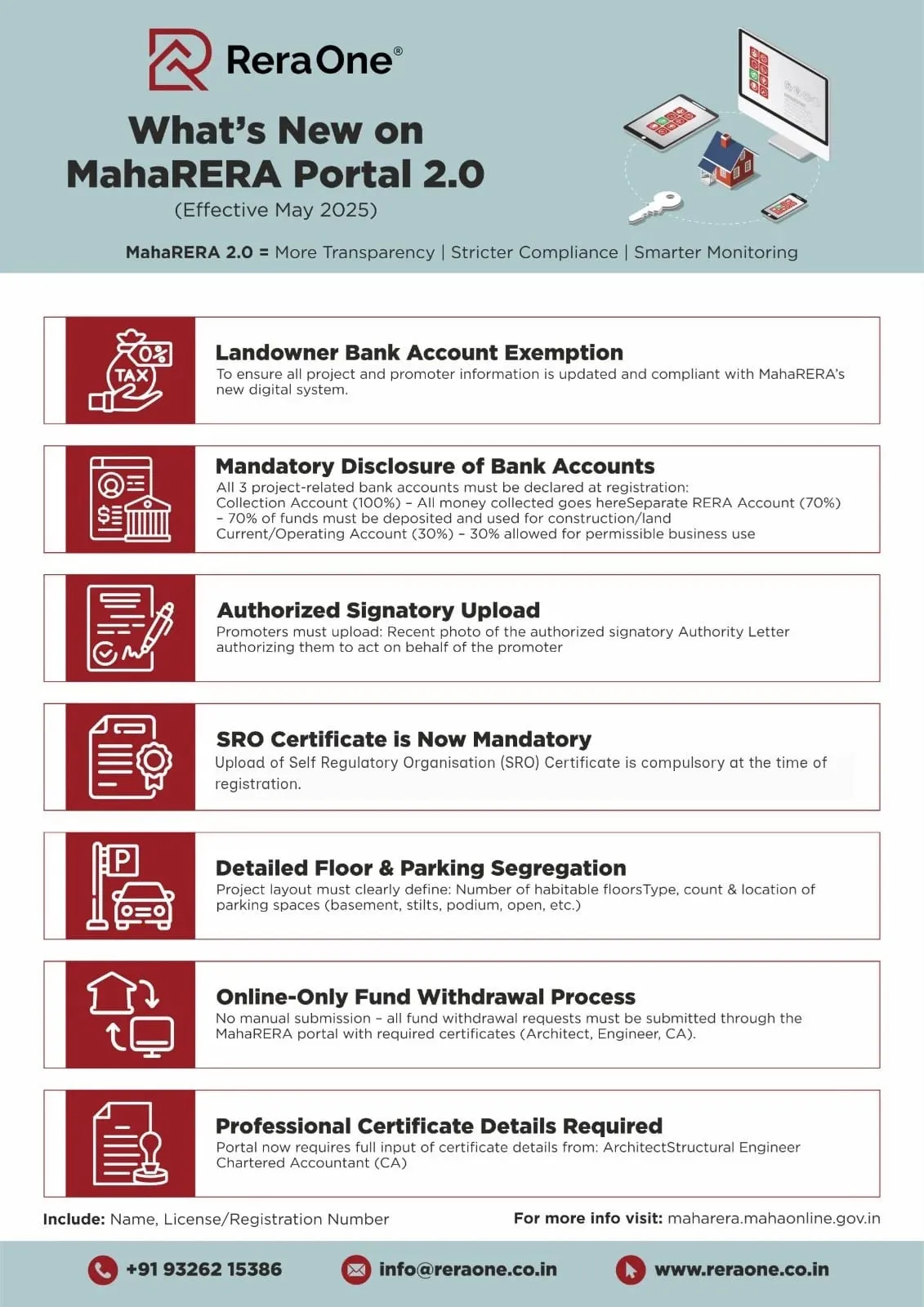
The new policy on landowner bank account exemption is one of the most notable modifications in MahaRERA 2.0. In the past, under RERA regulations, landowners had to open a separate bank account where they kept money pertaining to a real estate project. Nevertheless, MahaRERA 2.0 has changed the rule, and currently, landowners can skip this mandate in case they provide a formal statement.
This statement should indicate that the landowner will not sell, transfer, and/or establish third-party rights on the flats assigned in the project until the Occupancy Certificate (OC) is provided. This rule is meant to make sure that the funds and inventory of the project are under the control of the promoter until the project is completed. The update enables landowners not to have to go through a lot of unnecessary paperwork and offers a more flexible system for promoters to utilize project funds in an efficient way.
To ensure that they comply with the requirements of the MahaRERA 2.0, promoters ought to read the new exemption criteria and make sure that they are fulfilling the requirements. To get more information, the ReraOne portal provides sources and directions to assist promoters in dealing with these changes.
MahaRERA 2.0 enhances the financial transparency that makes promoters reveal all the bank accounts of the projects. Promoters are now mandated to open three separate RERA-designated bank accounts, each for specific purposes as per Section 4(2)(i)(D) of the Real Estate (Regulation and Development) Act, 2016. These accounts include:
These are special accounts that are meant to avoid diversion of funds, and the funds intended to be used in the construction and acquisition of land should be used properly. Under MahaRERA 2.0, promoters should also send in their project reports on loans taken by them with financial institutions. This will play a pivotal role in making both home buyers and regulators transparent.
MahaRERA 2.0 ensures faster and more orderly refunds of homebuyers: in the event of cancellation of a homebuyer booking, the promoter will be required to repay 70% of the amount of the Separate Account and 30% of the amount of the Transaction Account. Promoters are advised to get acquainted with the new account structure and financial reporting requirements to understand their compliance.
To find out more about how to establish and operate these bank accounts, promoters need to refer to ReraOne, where detailed instructions and materials may be found.
Promoters are currently mandated by MahaRERA 2.0 to post certain information regarding their authorized signatory. This includes:
This is necessary as it increases accountability, as there must be a digital record of responsibility for each activity undertaken on behalf of the promoter. This step is critical towards transparency because the person who has the legal responsibility to ensure that the project complies should be the authorized signatory.
MahaRERA 2.0 is expected to minimize the possibility of misappropriation of authority and to ensure that there is no confusion in the leadership of the project. Promoters are expected to provide their signatories who are to sign on their behalf with all the requirements and have the capability to submit the required documentation as and when requested.
One major difference in MahaRERA 2.0 is that it now stipulates that the Self-Regulatory Organisation (SRO) Certificate must be uploaded at the time of registering the project. This certificate is used to confirm that the project meets the requirements of the industry, such as quality of construction, safety, and environmental standards.
The SRO certificate also guarantees that the project complies with the local regulations before it is subjected to. The process of early verification as per the MahaRERA 2.0 will bring an added level of scrutiny to the real estate development process, enhancing the overall project transparency. To prevent delays in approving projects, promoters can make sure that they have acquired the SRO certificate prior to starting the registration process.
The ReraOne portal will also provide more specific instructions on how to acquire the SRO certificate and submit it to the promoters.
The critical change in MahaRERA 2.0 is a compulsory submission of floor and parking segregation plans. The project layouts should specify:
The purpose of this requirement is to promote transparency of the number of parking spaces and the type of parking spaces used in the project. It also explains the residential and non-residential units, which later can be used to avoid future conflicts between developers and allottees over building designs and allocation of parking areas.
For promoters, this translates to more clarity in project design and increased confidence on the part of the homebuyers. Promoters should also make sure that their project layouts are in line with these requirements to prevent any hassles when registering their projects.
The other important aspect of MahaRERA 2.0 is that promoters must provide details of professional certificates, such as:
This is needed to make sure that everyone working on the project, including the architects, engineers, and surveyors, is appropriately certified and responsible. It is also an added transparency in ensuring everything in the project is in line with regulations.
This new provision under MahaRERA 2.0 will contribute to creating a more robust regulatory framework, as professionals will be held accountable for their practice. Promoters are to make sure that all professional certificates are current and are easily accessible to be submitted in the process of registration.
With the launch of MahaRERA 2.0, it is not merely an upgrade but a total change of the real estate regulation system in Maharashtra. The advantages of the new system are:
MahaRERA 2.0 is an opportunity to gain credibility and trust in the marketplace from promoters. For homebuyers, it implies increased protection and increased confidence in the real estate market.
As MahaRERA 2.0 becomes compulsory in May 2025, an audit of promoters in their documentation, financial systems, and certifications in their professions is urgent. The MahaRERA 2.0 message is obvious:
Transparency is no longer optional—it's system-embedded.
The promoters that will be able to adjust to the new compliance rules will not only escape regulation problems, but they will also develop a good reputation in the Maharashtra real estate market. To guide them through the changes, ReraOne provides extensive resources to enable promoters to be fully compliant with MahaRERA 2.0 regulations.
Our experts are here to help.