Consider waking up to a formal communication that might freeze your bank account for the project, limit your sales, or even cancel your project registration.
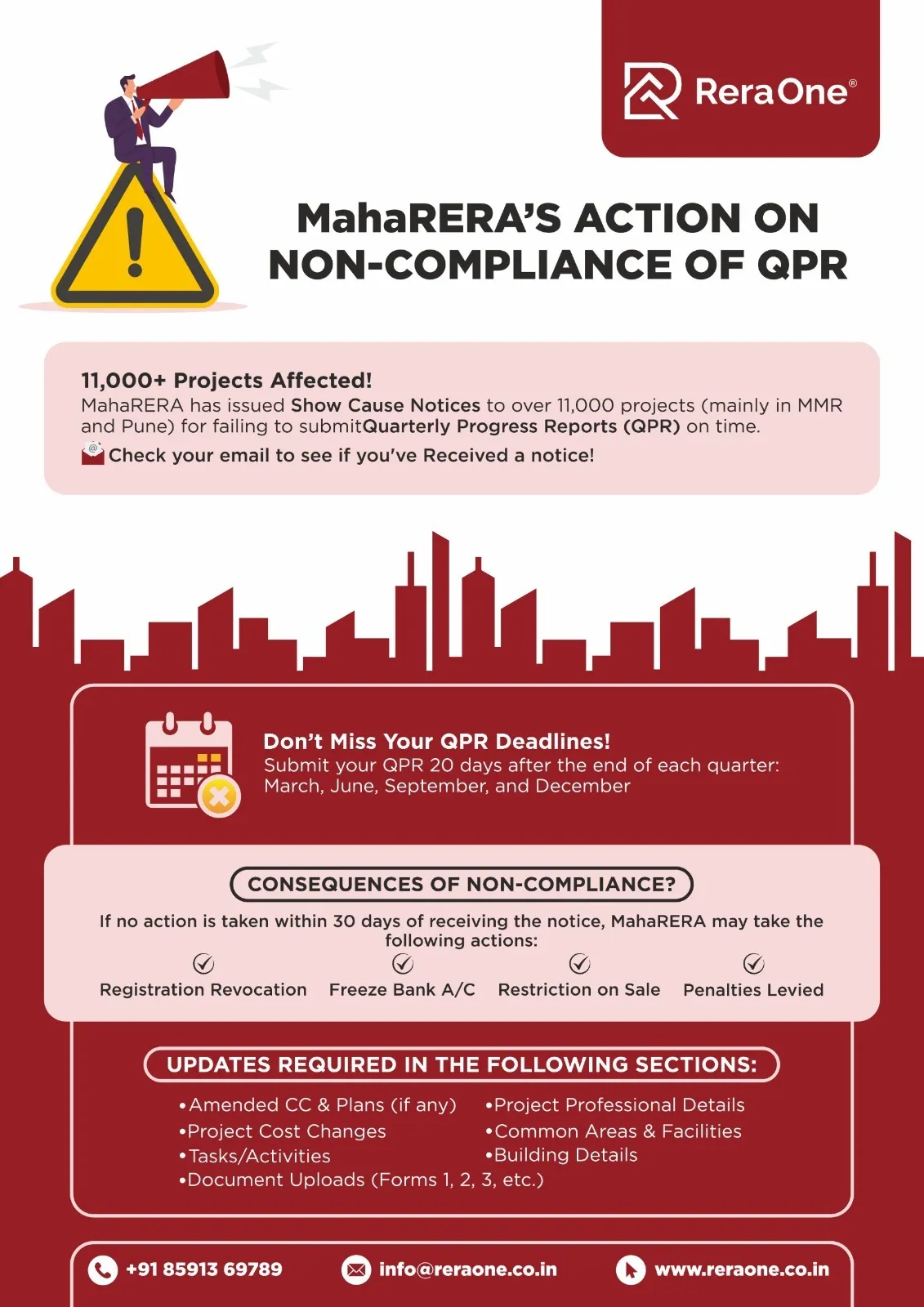
This might be considered an extreme, but for more than 11,000 Maharashtra real estate projects, this has become a reality due to failure in MahaRERA QPR compliance.
The Maharashtra Real Estate Regulatory Authority (MahaRERA) has been imposing strict measures on those projects that did not file their Quarterly Progress Reports (QPR) on time. This action shows a significant change in terms of enforcing the regulations, which is where adherence is checked rigorously by using digital systems, and the delays are no longer accepted.
This situation is not just a warning but also a turning point in the real estate industry.
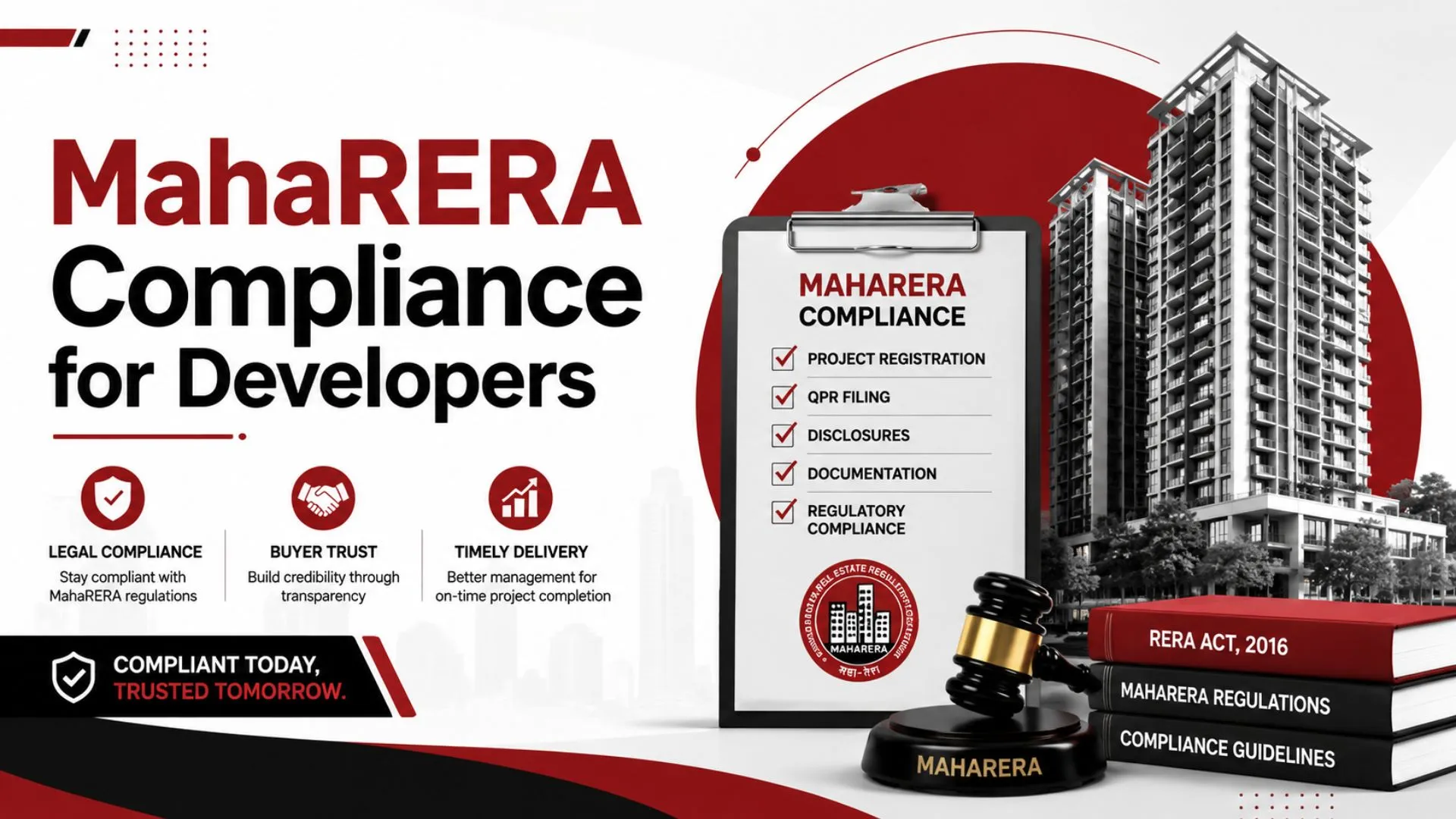
MahaRERA QPR compliance means the mandatory submission of Quarterly Progress Reports as required by the Real Estate (Regulation and Development) Act, 2016. These reports will be critical in ensuring transparency and accountability in real estate projects.
A QPR is not just a routine formality. It is a detailed update that provides information about different phases of a project lifecycle.
The most important aspects of QPR are:
MahaRERA QPR compliance will allow regulators and homebuyers to determine the project development progress against the promises. It keeps the developers accountable and buyers with access to quality information prior to making decisions.
The recent MahaRERA enforcement action is not random; it highlights growing concerns about non-compliance in the entire real estate industry.
Most projects were not successful in MahaRERA QPR compliance because:
However, the impact of such failures extends far beyond missed deadlines.
Impact of Non-Compliance:
MahaRERA has made it clear that compliance is no longer a secondary consideration by issuing notices to more than 11,000 projects.
It has become a key pillar of real estate governance.
One of the most important aspects of MahaRERA QPR compliance is adhering to strict timelines.
The developers are required to submit QPR within 20 days after the end of each quarter:
Although this timeline appears manageable, many developers face challenges due to operational inefficiencies.
Some of the common causes of delays are:
However, MahaRERA’s digital tracking system records every submission and delay.
In this system, compliance is evaluated based on timely submission, not intent.
Lack of proper MahaRERA QPR compliance may have severe consequences that directly affect the project operations.
Developers are required to explain their non-compliance within a specified timeframe.
Developers are not in a position to make sales unless they are successfully registered.
Budgets used in building can be limited, affecting the implementation of the projects.
The developers can be prohibited from selling units within the project.
Heavy fines may raise the cost of a project and decrease its profitability.
The implications of the loss of trust among buyers and investors might be long-term.
Obviously, the MahaRERA QPR compliance is directly related to the survival of a project and its further existence.
Most developers underestimate the complexity of QPR filings. Nevertheless, to be fully MahaRERA QPR compliant, proper and complete reporting is needed.
Developers are required to give stage-by-stage progress, such as work on the structure and finishing.
This involves new project costs, fund usage, and withdrawal information.
Any alterations in approved plans, approvals, or commencement certificates should be updated.
• Form 1 (Engineer)
• Form 2 (Architect)
• Form 3 (Chartered Accountant)
These certifications confirm the validity and authenticity of the data that is presented.
The data on sold and unsold units should be reported in an understandable manner.
Failure to file complete or accurate filings, even within the required time frame, may lead to regulatory action.
The role of compliance in real estate has changed greatly over the years.
In the past, compliance has been viewed as a back-office and last-minute activity. In the current times, the MahaRERA QPR compliance has become an essential part of the operations.
The importance of this Shift is that:
Those developers who change and incorporate compliance in the processes are more successful.
Compliance is no longer a liability- it is a competitive advantage.
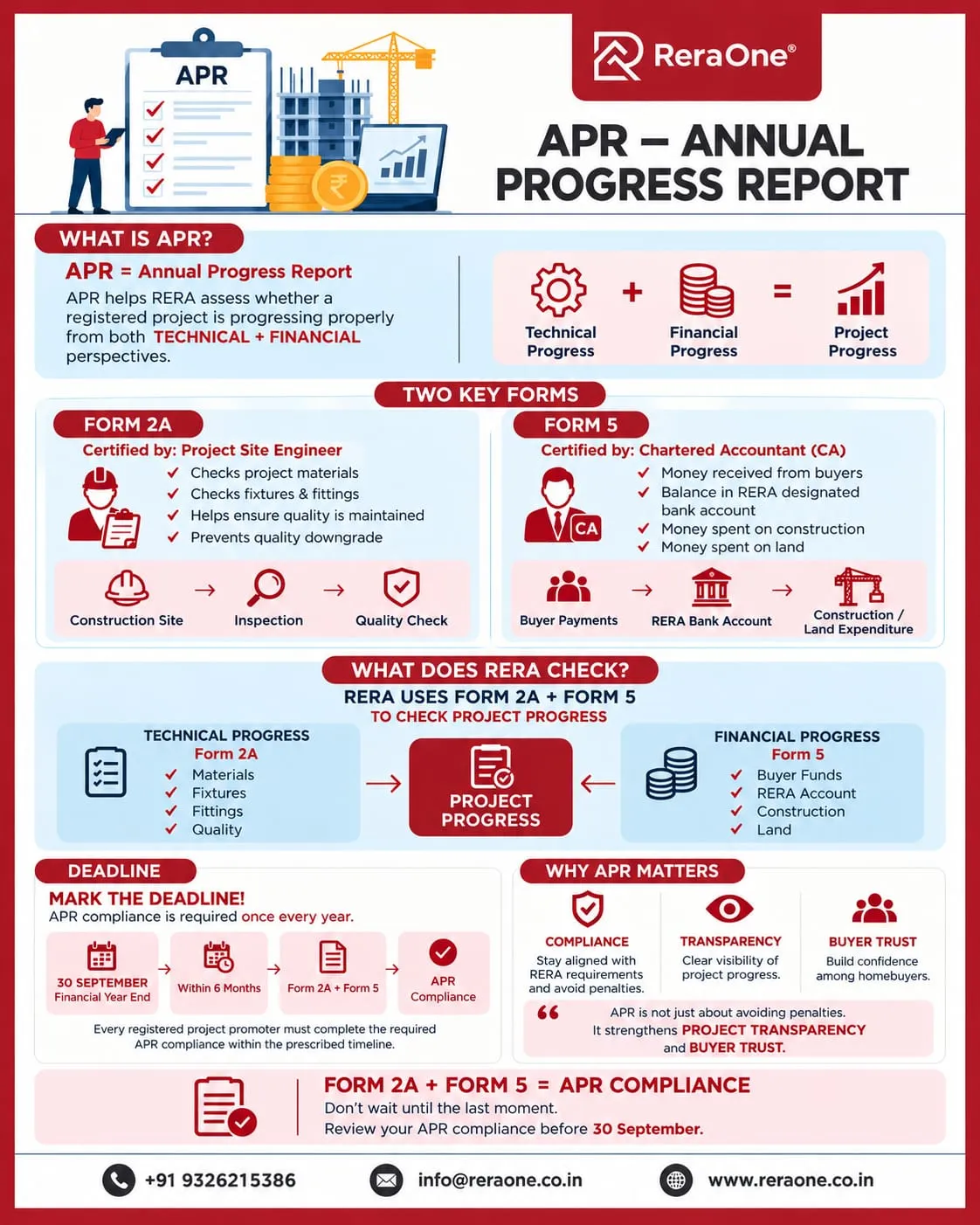
Besides the quarterly reporting, the developers also have to provide the Annual Progress Report (APR).
Whereas QPR gives brief updates on a short-term basis, APR gives a detailed annual report about the project.
Form 2A
This form, issued by the engineer, guarantees the quality of construction, structural stability, and adherence to technical standards.
Form 5
This form is issued by a statutory auditor and confirms that money raised from buyers is utilized in the project and in compliance with the progress of the completion.
APR enhances the MahaRERA QPR compliance through accountability and financial discipline in the long term.
Although this is important, most developers have difficulties in ensuring compliance.
Lack of a well-organized compliance calendar.
Unfinished or late financial and construction information.
Slowness of the engineer, architect, and auditors' input.
Poor knowledge of specific compliance needs.
The identified challenges are the first steps to enhancing compliance processes.
The developers are encouraged to embrace the following best practices in order to ensure smooth compliance and prevent penalties:
Pre-track deadlines of all QPR submissions.
Keep up-to-date to prevent last-minute mistakes.
Make certifications of engineers, architects, and CAs timely.
Check all information prior to submission.
Compliance risks can be greatly mitigated with professional guidance.
Compliance management can be daunting, in addition to construction, financial planning, and sales.
That’s where ReraOne plays a crucial role.
At ReraOne, we are experts in offering end-to-end services to MahaRERA QPR compliance, and your project will not have to worry about being out of compliance without the extra stress.
Our Services Include:
We assist developers in being reactive to compliance management as opposed to proactive compliance management.
With ReraOne, compliance becomes seamless and efficient.
Real estate compliance is becoming more stringent and technologically oriented in the future.
Key Trends:
This changing environment requires developers to adjust and incorporate MahaRERA QPR compliance as part of their business.
The move against over 11,000 projects is a good reminder that MahaRERA QPR is of utmost importance to any developer.
It is not merely a question of eluding punishments--it is about:
Having the right systems, organized procedures, and professional assistance of ReraOne, compliance may turn out to be a smooth and strategic aspect of project management.
In today’s real estate world, compliance enthusiasts would not just survive but thrive.
Our experts are here to help.